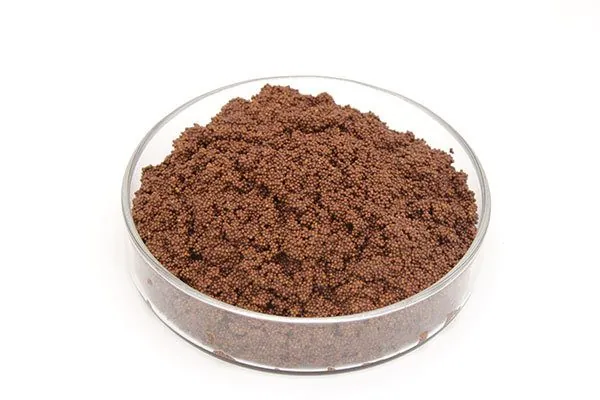
D418
D418 is a macroporous styrene-divinylbenzene chelating resin bearing aminophosphonic (aminomethyl phosphonic acid) groups. It chelates virtually all divalent metal ions with particular selectivity for alkaline-earth metals and is an ideal brine-softening resin. It removes divalent cations from industrial wastewater and process water, and is mainly used for polishing secondary brine in ion-membrane chlor-alkali plants, reducing Ca and Mg to 20 ppb; its exchange capacity and mechanical strength surpass comparable imported aminophosphonic resins. It is also used for recovering heavy metals from electroplating wastewater.
Product Introduction
D418 is a macroporous styrene-divinylbenzene chelating resin bearing aminophosphonic (aminomethyl phosphonic acid) groups. It chelates virtually all divalent metal ions with particular selectivity for alkaline-earth metals and is an ideal brine-softening resin. It removes divalent cations from industrial wastewater and process water, and is mainly used for polishing secondary brine in ion-membrane chlor-alkali plants, reducing Ca and Mg to 20 ppb; its exchange capacity and mechanical strength surpass comparable imported aminophosphonic resins. It is also used for recovering heavy metals from electroplating wastewater.
Typical Physical & Chemical Properties
| Appearance | Light yellow opaque beads |
|---|---|
| Shipped form | Na+ form |
| Moisture content | 55%~65% |
| Ca chelating capacity | ≥14g/L |
| True density (wet) | 1.10~1.18g/ml |
| Bulk density (wet) | 0.7~0.8g/ml |
| Particle size range | 0.315~1.25mm |
| Particle size range | ≥95% |
Handling, Storage & Loading Notes
- Transport & storage. Store the resin in its wet state, preferably above 0 °C. For long idle periods, keep the container closed or add brine of ≥5% NaCl. Protect from freezing during transport, and do not stack heavy objects on top of the resin to avoid crushing the beads.
- Pre-treatment. For general requirements, one alkaline → water → acid → water cycle is sufficient; for strict requirements, perform three cycles and finish with the required ionic form.
- Loading. Allow for the swelling on form conversion and leave enough freeboard to prevent overflow while keeping a proper liquid level. Keep the column aspect ratio in a reasonable range to avoid channeling. Load wet or backwash to remove air bubbles from the bed.
- Feed quality. Before entering the resin column, the liquid should be coagulated, filtered or sand-filtered to ensure it is free of suspended solids that could clog the resin pores.
- Idle columns. Resin left idle in a column for a long time must be washed out and stored clean, or kept submerged in brine; it must never dehydrate. Backwash from time to time to loosen the bed and prevent caking.