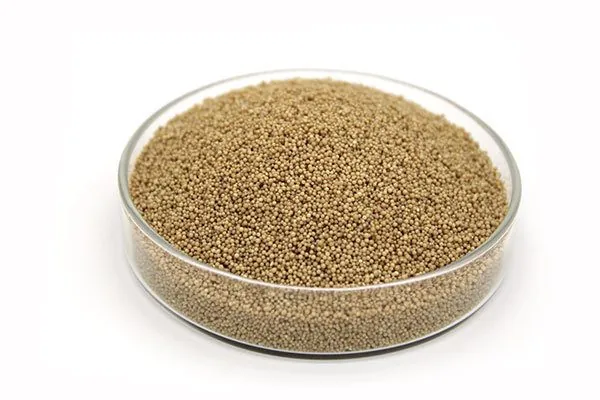
A standard strong acid cation resin will remove copper from water, but it will remove calcium just as happily - and at the concentrations found in plating rinse water, calcium usually wins on equivalents. Chelating resins solve that by forming a coordination complex with the transition metal, so the selectivity order is driven by chemistry rather than by concentration.
1. Choose the chelating chemistry first
| Functional group | Strongest for | Working pH | Notes |
|---|---|---|---|
| Iminodiacetate (IDA) | Cu, Ni, Zn, Co, Cd, Pb | 2-5 (falls away below pH 2) | The general-purpose workhorse; cheap regenerant, fast kinetics |
| Aminophosphonic | Fe(III), Al, Cu, Ni, U, rare earths | 1-4, tolerant of very low pH | Works where IDA loses capacity; harder to strip fully, needs stronger acid |
| Amidoxime | U, Cu, Fe | Neutral to mildly alkaline | Speciality grades for uranium and seawater duties |
| N-methylglucamine | Boron (as boric acid) | 6-9 | Needs a pH swing between loading and elution; not a metal resin at all |
For most plating rinse water and printed-circuit-board effluent, IDA is the correct first choice. Move to aminophosphonic when the stream is genuinely acidic (below pH 2) or when iron is the target.
2. Selectivity is the design constraint
On an IDA resin the approximate affinity order is:
- Cu(II) > Pb(II) > Ni(II) > Zn(II) > Co(II) > Cd(II) > Fe(III) > Mn(II) > Ca(II) > Mg(II) > Na(I)
- The gap between copper and calcium is what makes the technology work - a resin loaded with calcium will still strip copper from the same stream
- Iron(III) sits high on the list but is slow to strip; in practice it accumulates and blocks sites. Remove iron upstream if it is above a few mg/L
3. The pH window is the whole design
Chelating capacity is a strong function of pH, and the curve is steep. For IDA resins the practical window is roughly pH 2 to 5: above pH 5 the metal may precipitate as hydroxide and foul the bed, below pH 2 the amine nitrogen is protonated and the metal is released - which is exactly how regeneration works.
- Loading at pH 3-4 gives the best combination of capacity and selectivity, and keeps most metals soluble
- If the stream is alkaline, adjust pH down before the column, not inside it
- If the stream is strongly acidic (pickling liquors, pH below 1), use aminophosphonic rather than IDA
- Elution needs pH below 1.5 for complete stripping; a partial strip leaves a heel that slowly blinds the bed
4. Sizing rules that hold in practice
- Total capacity is typically 0.4-0.5 eq/L, which is roughly 12-16 g of divalent copper per litre of resin at full loading on an equivalents basis - use 60-70% of that as the working capacity
- Flow: 8-20 BV/h for dilute rinse water; slower for concentrated streams
- Bed depth of at least 800-1,000 mm, and a minimum of 2-3 minutes of contact time
- Temperature below 60 C; above that, oxidation of the chelating group shortens life noticeably
- Allow for 20-30% bed expansion on backwash and for the shrinkage that follows acid elution
5. Regeneration and what to do with the eluate
Elute with 1-2 BV of 4-8% HCl, or 5-10% H2SO4 where sulphate is acceptable, at 2-4 BV/h and ambient temperature. The first 0.3-0.5 BV is the rich cut, typically 5-20 g/L of metal - concentrated enough for electrowinning, crystallisation or straightforward hydroxide precipitation. Keep it separate from the rinse water, or you turn a valuable stream into a disposal problem.
Where a plant can use the recovered metal, the resin often pays for itself: rinse water that was sent to the effluent plant becomes a copper sulphate or nickel chloride solution that goes back into the bath. Where it cannot, the resin still cuts the volume of metal-bearing waste by an order of magnitude.
6. Where chelating resins earn their price
- Electroplating and anodising rinse water - copper, nickel, zinc at 5-200 mg/L, with hardness present
- Printed circuit board and plating-shop effluent polishing to discharge limits
- Mine water and smelter scrubber liquors - copper, cobalt, nickel, uranium recovery
- Cobalt and nickel purification in battery-salt production
- Groundwater remediation where metals must go below 0.1 mg/L in the presence of hardness
Need help with this duty?
Send your water analysis, flow rate and target quality — we will come back with a resin recommendation and a regeneration estimate.
More technical articles
- How to Select an Ion Exchange Resin: A Practical Checklist for Process Engineers
- Regenerating Strong Acid Cation Resin: Acid Dosage, Concentration and Flow Rate
- Ion Exchange Resin Fouling: How to Diagnose It and Clean It Without Damaging the Bed
- Gold Adsorption Resins and Industrial Recovery Processes
- PFAS Selective Adsorption Resin: Operating Instructions from Influent to Replacement
- Uranium Adsorption Resins and Industrial Extraction Processes
- CO2 Adsorption Resins and Solid-Sorption Carbon Capture Processes