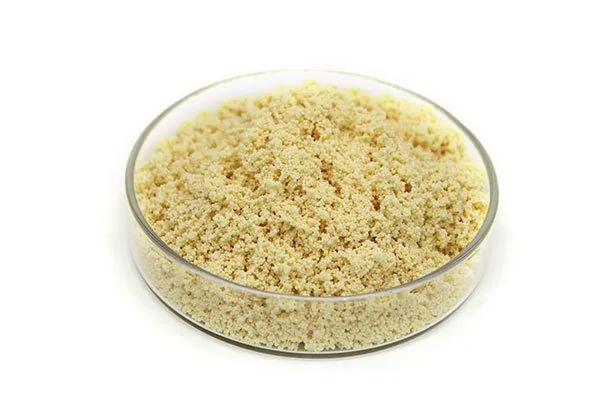
H103
H103 is a macroporous (macroreticular) non-polar adsorption resin of the polystyrene family, developed for the adsorption and separation of small organic molecules. A special manufacturing process gives it very uniform pore size and high specific surface area. It is widely used for removing organic residues from wastewater, food products, agricultural produce and herbal (TCM) extracts.
Product Introduction
H103 is a macroporous (macroreticular) non-polar adsorption resin of the polystyrene family, developed for the adsorption and separation of small organic molecules. A special manufacturing process gives it very uniform pore size and high specific surface area. It is widely used for removing organic residues from wastewater, food products, agricultural produce and herbal (TCM) extracts.
Typical Physical & Chemical Properties
| Appearance | Dark brown opaque beads |
|---|---|
| Resin structure | PSt |
| Polarity | Non-polar |
| Moisture content | 45%~55% |
| True density (wet) | 1.05~1.10g/ml |
| Bulk density (wet) | 0.70~0.75g/ml |
| Specific surface area | 1000~1200m3/g |
| Average pore diameter | 8.5~9.5nm |
| Porosity | 55%~60% |
| Particle size range | 0.3~1.25mm |
Handling, Storage & Loading Notes
Transport & storage: The resin contains water; keep the temperature between 5 and 40 °C during storage and transport to prevent freezing or mold. If the resin has dried out by exposure to air, do not add water directly (it will float) — soak it in ethanol to restore its wet state, then rinse thoroughly with clean water.
Feed quality: The adsorbate solution should be clarified and filtered before entering the column to keep impurities out and avoid acute poisoning of the resin.