201×8FG
Lijiang 201×8FG is a gel-type strong base (Type I) anion exchange resin on a polystyrene-divinylbenzene matrix, bearing quaternary ammonium groups –N(CH₃)₃ — the solid equivalent of a strong base. High total exchange capacity and good mechanical strength; mainly used in food-grade water treatment and related purification processes.
Inquire Now
Tel: +86 15612044421
Product Introduction
Lijiang 201×8FG is a gel-type strong base (Type I) anion exchange resin on a polystyrene-divinylbenzene matrix, bearing quaternary ammonium groups –N(CH₃)₃ — the solid equivalent of a strong base. High total exchange capacity and good mechanical strength; mainly used in food-grade water treatment and related purification processes.
International Equivalents
Amberlite IRA-400, AB-17, Diaion SA-10A
Typical Physical & Chemical Properties
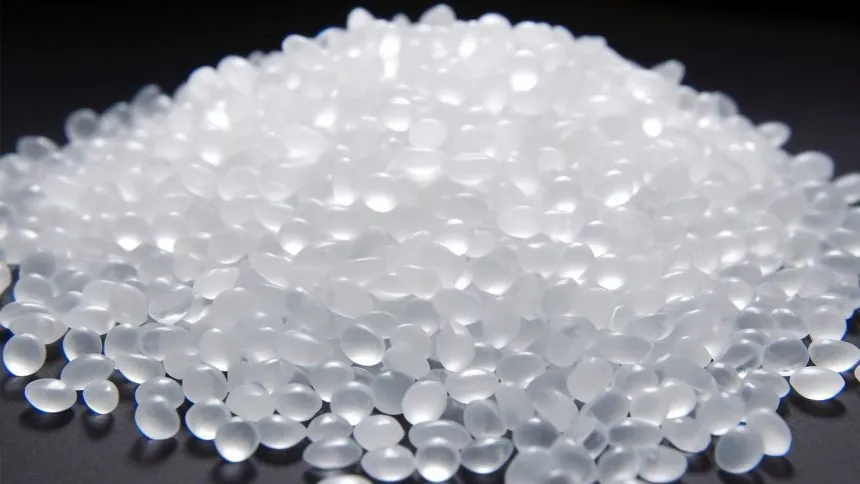
| Appearance | White to pale yellow translucent beads |
|---|---|
| Total exchange capacity | ≥3.8mmol/g |
| Volumetric exchange capacity | ≥1.5mmol/ml |
| Moisture content | 43%~47% |
| True density (wet) | 1.06~1.10g/ml |
| Bulk density (wet) | 0.66~0.71g/ml |
| Particle size range | 0.315~1.25mm |
| Effective particle size | 0.40-0.70mm |
| Uniformity coefficient | ≤1.6 |
| Osmotic-attrition whole bead rate | ≥60% |
| Chromaticity | ≤25APHA |
| Max. operating temperature | OH40 °C, CI100 °C |
| Resin bed height | 1~3m |
| Service flow rate | 2~10BV/h |
| Backwash flow rate | 4~10BV/h |
| Regeneration (elution) flow rate | 1~2BV/h |
| Regenerant dosage | 2 BV 3~5% HCl, 2 BV 2~4% NaOH |
Handling, Storage & Loading Notes
- Transport & storage. Store the resin in its wet state, preferably above 0 °C. For long idle periods, keep the container closed or add brine of ≥5% NaCl. Protect from freezing during transport, and do not stack heavy objects on top of the resin to avoid crushing the beads.
- Pre-treatment. For general requirements, one alkaline → water → acid → water cycle is sufficient; for strict requirements, perform three cycles and finish with the required ionic form.
- Loading. Allow for the swelling on form conversion and leave enough freeboard to prevent overflow while keeping a proper liquid level. Keep the column aspect ratio in a reasonable range to avoid channeling. Load wet or backwash to remove air bubbles from the bed.
- Feed quality. Before entering the resin column, the liquid should be coagulated, filtered or sand-filtered to ensure it is free of suspended solids that could clog the resin pores.
- Idle columns. Resin left idle in a column for a long time must be washed out and stored clean, or kept submerged in brine; it must never dehydrate. Backwash from time to time to loosen the bed and prevent caking.