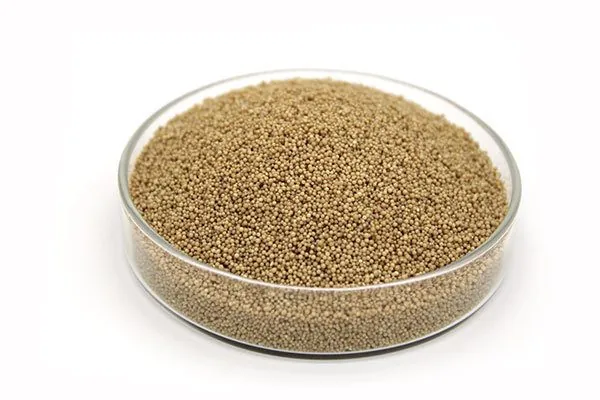
D201U
D201U is a macroporous strong base (Type I) anion exchange resin on a polystyrene matrix, bearing quaternary ammonium groups –N(CH₃)₃. It offers excellent resistance to physical attrition and chemical osmotic shock as well as good silica removal, and is mainly used for desalination, pure and ultrapure water production and condensate polishing. It is mainly used in hydrometallurgy and is suitable for uranium extraction.
Product Introduction
D201U is a macroporous strong base (Type I) anion exchange resin on a polystyrene matrix, bearing quaternary ammonium groups –N(CH₃)₃. It offers excellent resistance to physical attrition and chemical osmotic shock as well as good silica removal, and is mainly used for desalination, pure and ultrapure water production and condensate polishing. It is mainly used in hydrometallurgy and is suitable for uranium extraction.
Typical Physical & Chemical Properties
| Appearance | Pale yellow translucent beads |
|---|---|
| Strong-base group capacity | ≥3.7mmol/g |
| Volumetric exchange capacity | ≥1.2mmol/ml |
| Moisture content | 50%~60% |
| True density (wet) | 1.06~1.10g/ml |
| Bulk density (wet) | 0.65~0.73g/ml |
| Particle size range | 0.7~1.6mm |
| Uniformity coefficient | ≤1.6 |
| Osmotic-attrition whole bead rate | ≥90% |
| Max. operating temperature | OH40 °C, CL100 °C |
| Resin bed height | 1~3m |
| Service flow rate | 2~10BV/h |
| Backwash flow rate | 4~10BV/h |
| Regeneration (elution) flow rate | 1~2BV/h |
| Regenerant dosage | 2 BV 3~5% HCl, 2 BV 2~4% NaOH |
Handling, Storage & Loading Notes
- Transport & storage. Store the resin in its wet state, preferably above 0 °C. For long idle periods, keep the container closed or add brine of ≥5% NaCl. Protect from freezing during transport, and do not stack heavy objects on top of the resin to avoid crushing the beads.
- Pre-treatment. For general requirements, one alkaline → water → acid → water cycle is sufficient; for strict requirements, perform three cycles and finish with the required ionic form.
- Loading. Allow for the swelling on form conversion and leave enough freeboard to prevent overflow while keeping a proper liquid level. Keep the column aspect ratio in a reasonable range to avoid channeling. Load wet or backwash to remove air bubbles from the bed.
- Feed quality. Before entering the resin column, the liquid should be coagulated, filtered or sand-filtered to ensure it is free of suspended solids that could clog the resin pores.
- Idle columns. Resin left idle in a column for a long time must be washed out and stored clean, or kept submerged in brine; it must never dehydrate. Backwash from time to time to loosen the bed and prevent caking.